7
Models across 5 families
AAAI 2026 · Under Review · Training-Free Structured Pruning
Defeating the high-sparsity collapse of structured LLM pruning with a calibration-only anchored continuation — separating a fixed dense anchor from a moving expansion point, with zero weight updates.
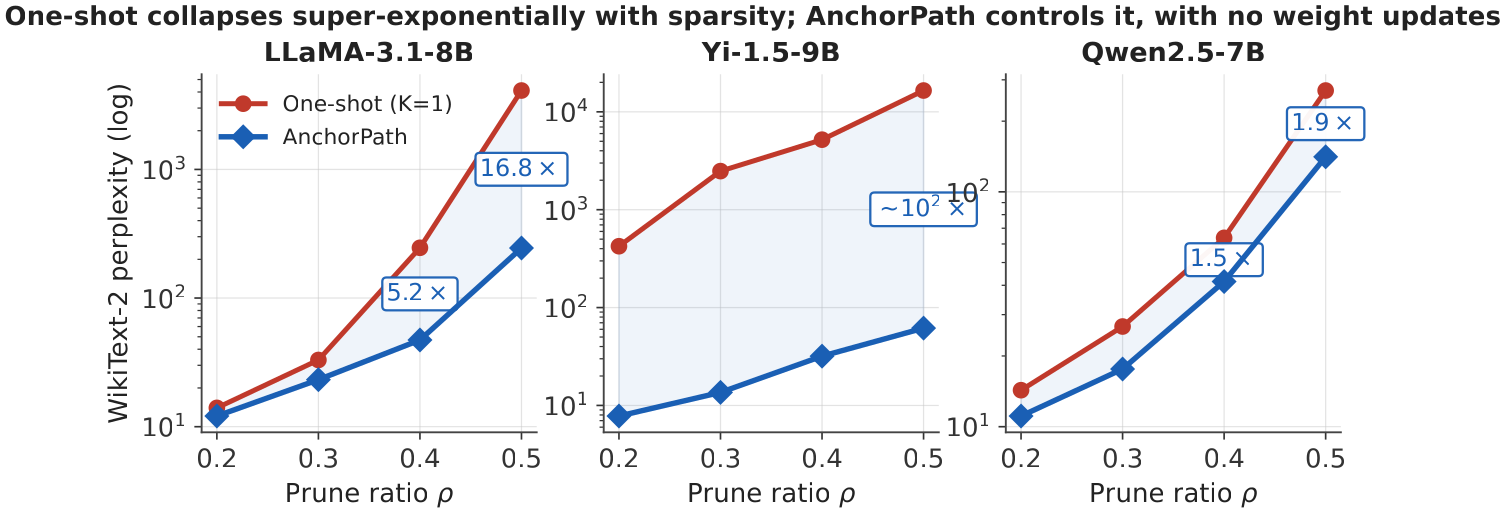
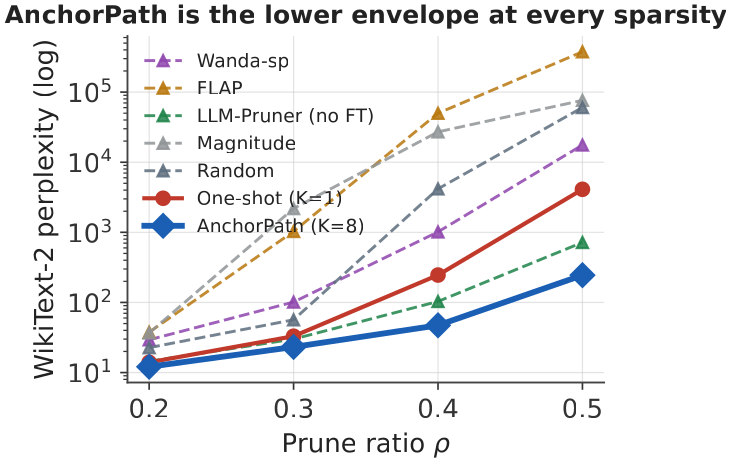
At 50% sparsity on LLaMA-3.1-8B, one-shot second-order pruning explodes to 4106 perplexity; AnchorPath holds it at 245 (16.8× lower) — and up to ~270× on Yi-1.5-9B — while changing only the mask.
Models across 5 families
Structured sparsity range
Lower perplexity vs one-shot at 50%
Exact ablation of our own method
Only the mask changes
Training-free structured pruning removes whole attention heads and FFN channel groups from a frozen LLM using only a small unlabeled calibration set — no gradients, no fine-tuning. Yet every one-shot method collapses at high sparsity.
We show this collapse is a property of the one-shot paradigm itself — a single second-order quadratic built at the dense model and extrapolated across the entire budget — not of the importance score. AnchorPath recasts compression as a calibration-only anchored continuation: it traces the pruning path in the cost budget, re-estimating local curvature at the current partially-pruned model while measuring damage against a fixed dense anchor.
Across seven models, AnchorPath is the lower envelope of the training-free baseline set and cuts perplexity by up to two orders of magnitude versus one-shot at 50% sparsity — while changing only the mask. One-shot second-order pruning is exactly the K = 1 case.
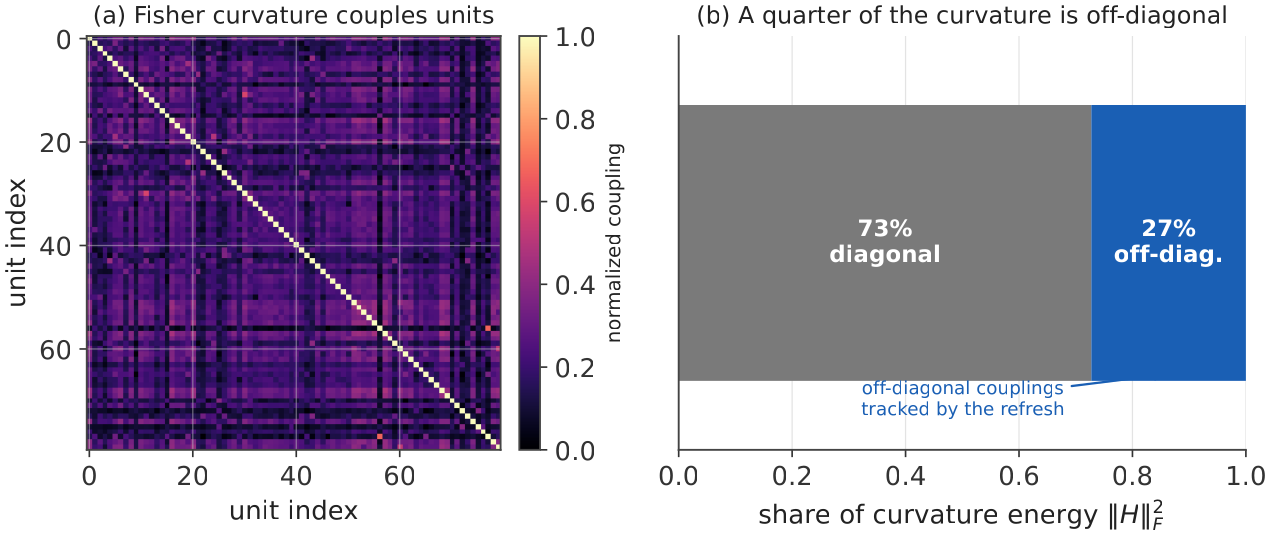
One-shot second-order pruning builds a single quadratic R(s) ≈ ½·sᵀH·s of the KL-to-teacher risk, measured at the dense model, then minimizes it over the whole budget. The map is faithful only near the dense point — deleting 40–50% of units carries you far outside its trust region, and neglected higher-order terms grow as the cube of the step.
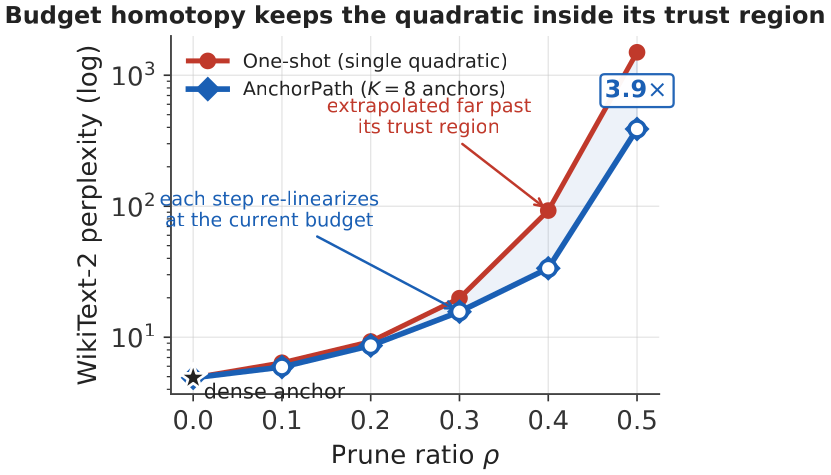
On LLaMA-2-7B, one-shot WikiText-2 perplexity runs 6.4 → 9.3 → 19.9 → 92.6 → 1497 at 10–50% — per-step inflation ×1.5, ×2.1, ×4.7, ×16.2 that accelerates. Two coupled causes: trust-region violation and operating-point drift — both about where the expansion is taken, so no importance score escapes it.
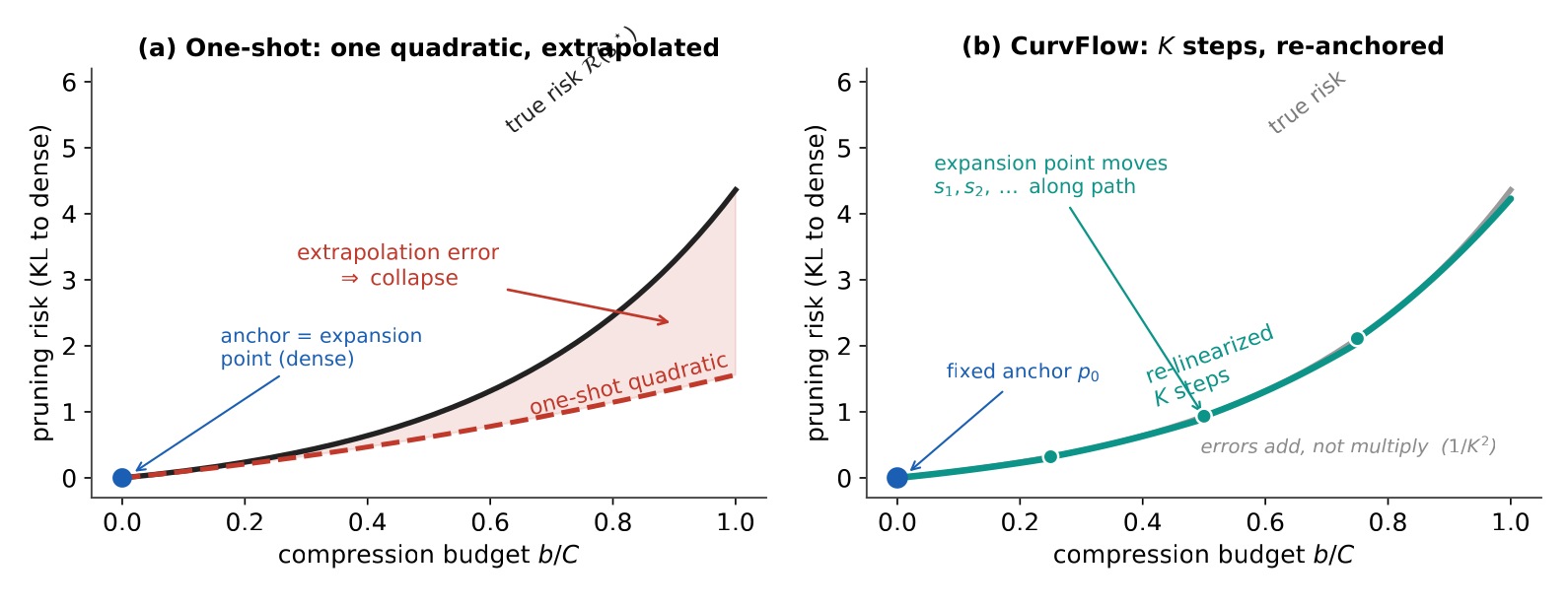
One-shot conflates two roles that AnchorPath pulls apart. Separating them revives a first-order drift term that one-shot discards by construction.
Instead of one quadratic spanning the whole budget, AnchorPath splits the budget into K bands and traces the constrained-optimal pruning path, re-estimating local curvature at each operating point. It is a continuation in the compression budget whose reference anchor stays fixed at the dense teacher. Nothing but the mask ever changes — no gradient descent, no reconstruction, no LoRA.
Cache the frozen dense teacher and step-0 curvature features from a small calibration set.
Output: teacher cache + the exact one-shot (K=1) starting point.
Trace the budget in K bands: estimate operating-point curvature, greedily fill each band, realize the mask.
Output: a path of masks that stays inside each fresh trust region.
Ship the final mask — structural units are physically removed. No recovery, no weight edits.
Result: a smaller model at the same deploy cost as one-shot, but far higher quality.
One-shot 4106 → AnchorPath 245
16.8× lower · 2.9× below the best baseline (LLM-Pruner 718).
One-shot 16510 → AnchorPath 61.7
~270× lower — nearly two orders of magnitude.
Best in 28/28 cells vs one-shot; ≥ LLM-Pruner on 24/24.
The lower envelope of every training-free baseline at 50% on all seven models.
Hint: scroll horizontally to view all columns on smaller screens.
| Method | ρ=0.2 | ρ=0.3 | ρ=0.4 | ρ=0.5 |
|---|---|---|---|---|
| Random | 22.7 | 56.6 | 4168 | 60360 |
| Magnitude | 36.7 | 2184 | 27101 | 76313 |
| Wanda-sp | 29.4 | 101.4 | 1015 | 17611 |
| FLAP | 37.6 | 1030 | 49940 | 376017 |
| LLM-Pruner | 14.5 | 30.0 | 103.3 | 718.2 |
| One-shot (K=1) | 14.0 | 33.0 | 245.9 | 4106 |
| AnchorPath (K=8) | 12.1 | 23.2 | 47.2 | 245 |
| Gain vs one-shot | 1.2× | 1.4× | 5.2× | 16.8× |
| Model | One-shot (K=1) | AnchorPath | Gain |
|---|---|---|---|
| Yi-1.5-9B | 16510 | 61.7 | ~270× |
| LLaMA-3.1-8B | 4106 | 245 | 16.8× |
| LLaMA-3.2-3B | 3027 | 325 | 9.3× |
| LLaMA-2-7B | 1497 | 389 | 3.9× |
| Qwen2.5-14B | 300.8 | 156 | 1.9× |
| Qwen2.5-7B | 270.1 | 141 | 1.9× |
| Falcon3-7B | 62.5 | 27.8 | 2.2× |
| Steps K | 1 | 2 | 4 | 8 |
|---|---|---|---|---|
| WikiText-2 ppl | 1497 | 1205 | 823 | 389 |
Monotone, diminishing returns — a 3.9× reduction from re-centering alone. K never hurts; K=1 recovers one-shot exactly (Jaccard 1.0).
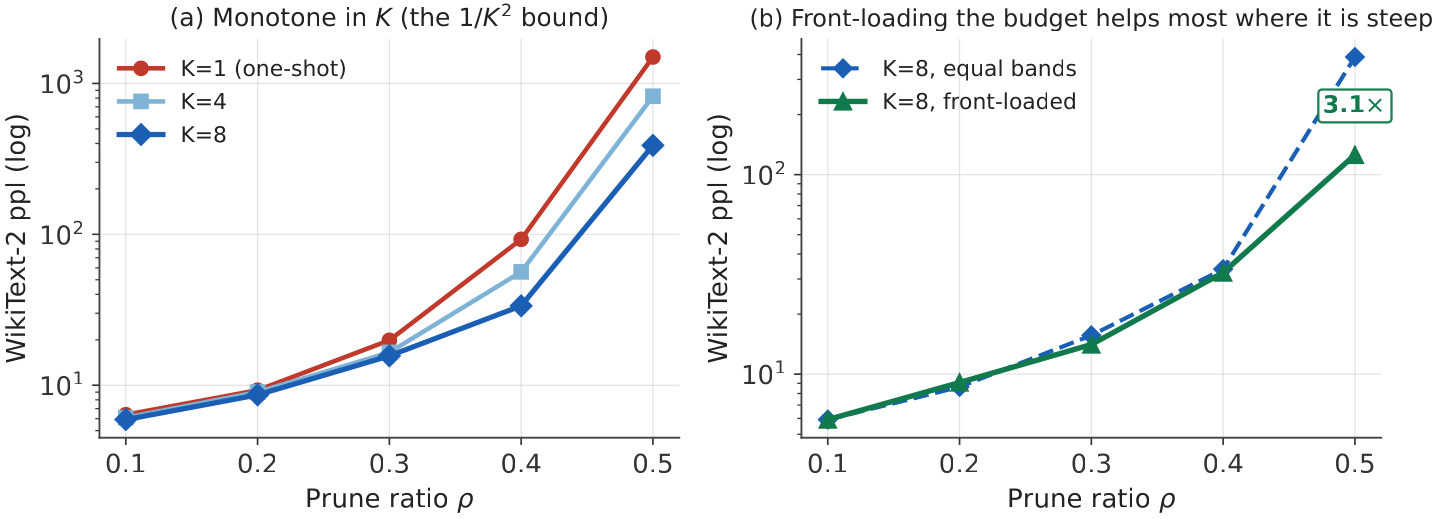
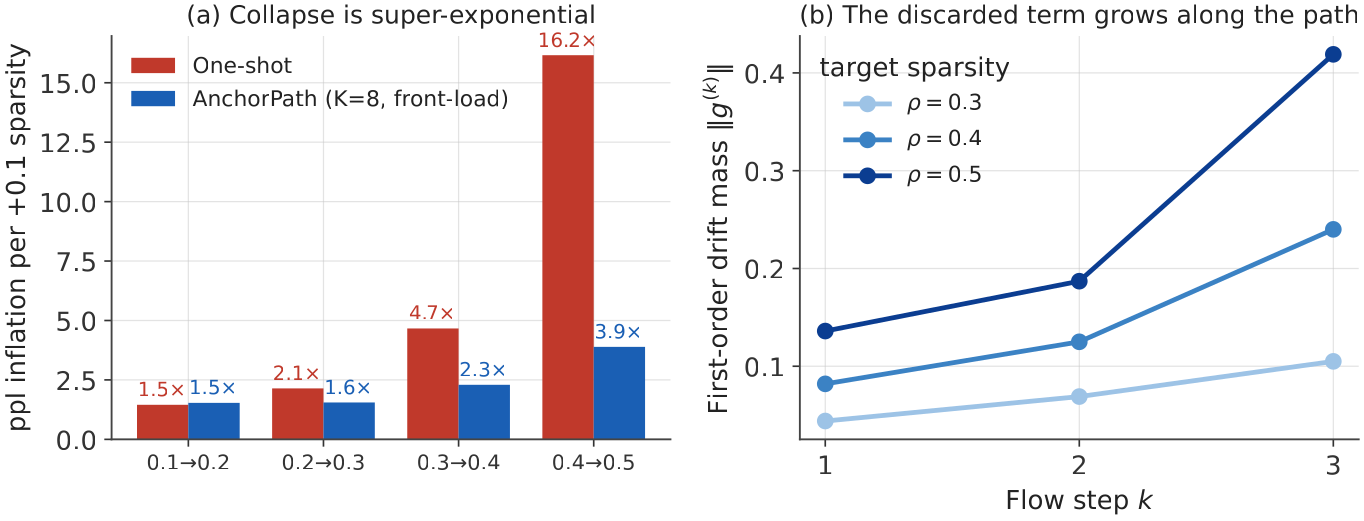
One-shot 1497 → multi-step (K=8) 389 → front-loaded schedule 126 (11.9× total on the sharpest-collapse model). Removing the drift term g regresses 389 → 668 — and is inert at low sparsity, mattering exactly where drift mass is large. Equal-cost bands are the universal default; the safety rails are conservative, not the source of the gain.
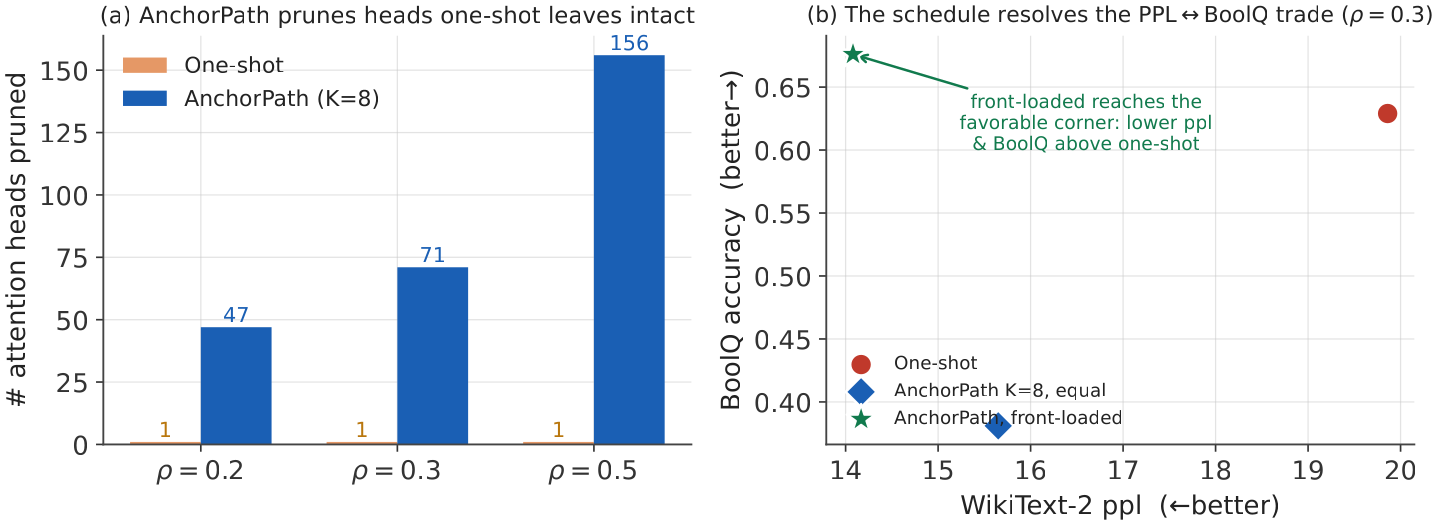
Because only the mask changes, the improvement is fully traceable. AnchorPath prunes many attention heads — 47 / 71 / 156 heads at 20 / 30 / 50% sparsity — where one-shot prunes at most one at every ratio. Those heads look cheap only from the dense point; the anchored continuation sees the damage they cause once the model has already moved.
On the perplexity–accuracy plane, the front-loaded schedule reaches BoolQ 0.676 > one-shot 0.629 while also lowering perplexity — one-shot is a strictly dominated point.
AAAI 2026 submission — under review. Coming soon.
Reference implementation and one-command reproduction. Coming soon.
A narrated, animated ~7-minute video tour — the collapse, the anchored continuation, and the results, built for a general audience.
For questions about this project, contact zhiren001@e.ntu.edu.sg.